Update: Blogger Maikel Nabil was released on 23 January, one day after the attacks and three days before the time announced. He was released at night so that no one would be there waiting for him. He released the above video on the night of 24 January 2012.
Friday, January 27, 2012


Sunday, January 22, 2012
Maikel Nabil’s Release - Not a Great Day for Freedom
Yesterday in a publicity stunt to appease the masses ready to revolt once again, the SCAF issued pardons to 1959 military prisoners including the first prisoner of conscience Maikel Nabil. Military sources as well as Maikel Nabil’s lawyer Amir Salem confirmed that the prisoners would be released the following day.
Mark Nabil(@mark_nabil), Maikel Nabil’s brother tweeted that we would meet at 8 am opposite Tora El Balad metro station to greet Maikel when released. We arrived a little past 8.30. Mark and his father had not yet arrived. The weather was gloomy and cold, and the sky was scorched with gray, but the excitement over a possible release of Maikel Nabil was worth it. I was glad to see Max Strasser (@maxstrasser) who shared my excitement. We moved towards the prison a little after Mark arrived. There were a little over 10 of us.
Mark went to the prison gate in order to ask about Maikel’s status and he was informed by the officer at the gate that the decree (the paper to release Maikel by the military judiciary) had not yet arrived. The sky could not make up its mind whether it would rain or not. It drizzled ever so slightly every once in a while. Mark suggested we wait at a coffee shop till the papers came through. We sat at a coffee shop our number had risen to around 18 people or so. Meanwhile he and his father made calls to Maikel’s lawyer, Amir Salem, in order to determine what was holding things up. Salem said he would have them fax the decree over to the prison. We didn’t know if that was a success.
Mark going back and forth informed us of the news. He said an officer told him that Maikel will not be released today. Mark’s father said we could wait outside and possibly start a sit-in, but it didn’t seem realistic with the small numbers. We got up and what looked like a high ranking officer said ‘Mabrook’ from inside his car. We responded that Maikel wasn’t going to be released today according to another officer, and he said that they were actually just waiting for the fax.
There was a lot of confusion as to what was really happening, with various calls to Maikel’s lawyer and uncertainty about whether Maikel would be released. Then came another piece of news; that Maikel and others would probably be released on 26 January, possibly for concerns over them joining the 25 January protests.
We stood outside the prison door, the one we had stood outside before when organizing a protest for the release of blogger and activist Alaa Abdel Fattah (@alaa). We didn’t know if they were giving us this information because it was true or if they just wanted us dispersed.
The residents gathered round and some began discourse over what we were doing. We had to explain that this wasn’t a protests, we were not chanting and we were just waiting for our friend Maikel. They asked us not to do anything that would bring them harm.
One of them was a driver of a toktok with a degree in commerce. He said he understands SCAF’s games with the petrol, the gas and all the austerity measures to force us to succumb, but he also said he was barely struggling and he was humiliated driving a toktok. He told us that not everyone in the neighborhood would be as understanding as he is. He asked us to move to a side. It seems like we’ve become accustomed to stand in protest in the middle of the road rather than safely at the side. We complied so that we don’t bother the residents although it seemed pointless in such a road. More resident drama happened as they asked as to our purpose, unable to criticize us for waiting for someone who has already been pardoned. I would like to point out that there were foreigners at that time that weren’t given any trouble by the local residents. The residents were half rebuking, half inquiring.
We waited around, trying to find out from lawyers what the reality of the situation was, whether Maikel would be released today or not. Then came a change when some of the other ‘residents’ arrived. There were a few of them who looked like they were looking for trouble. One of them just shouted harassingly at women but was called by the officer at the gate and told not to use this style of harassment. Then after a while there came that same guy who stirred up trouble when we were protesting when Alaa was in custody. He was a man of reddish-white complexion, white hair, average build and spoke very roughly never waiting for a response. He praised the army and viciously asked us to leave as he headed away. Last time this happened, he came back with more of his buddies and started scuffles for no reason.
We decided to go back to the coffee shop and avoid confrontation. Some people decided to leave at that point. I wanted to stay but for I had leave for compelling reasons.
As I boarded the metro, I read Mark’s tweet, that they were confronted by people carrying sticks and knives. I later found out through Marina (@violin_queen) who was with us at the protest that they were threatened with murder if they ever came back to the neighborhood. She also tweeted that a photographer Michael Adel was taken inside Tora prison, beaten and threatened he would be killed. The citizens armed with knives and glass bottles then boarded a CSF truck that went inside Tora prison after their attack.
Related news: Prisoners ‘pardoned’ by Tantawi remain in prison
 |
| At the coffee shop next to Tora Prison. Photo by: Mark Nabil |
Mark went to the prison gate in order to ask about Maikel’s status and he was informed by the officer at the gate that the decree (the paper to release Maikel by the military judiciary) had not yet arrived. The sky could not make up its mind whether it would rain or not. It drizzled ever so slightly every once in a while. Mark suggested we wait at a coffee shop till the papers came through. We sat at a coffee shop our number had risen to around 18 people or so. Meanwhile he and his father made calls to Maikel’s lawyer, Amir Salem, in order to determine what was holding things up. Salem said he would have them fax the decree over to the prison. We didn’t know if that was a success.
Mark going back and forth informed us of the news. He said an officer told him that Maikel will not be released today. Mark’s father said we could wait outside and possibly start a sit-in, but it didn’t seem realistic with the small numbers. We got up and what looked like a high ranking officer said ‘Mabrook’ from inside his car. We responded that Maikel wasn’t going to be released today according to another officer, and he said that they were actually just waiting for the fax.
There was a lot of confusion as to what was really happening, with various calls to Maikel’s lawyer and uncertainty about whether Maikel would be released. Then came another piece of news; that Maikel and others would probably be released on 26 January, possibly for concerns over them joining the 25 January protests.
We stood outside the prison door, the one we had stood outside before when organizing a protest for the release of blogger and activist Alaa Abdel Fattah (@alaa). We didn’t know if they were giving us this information because it was true or if they just wanted us dispersed.
The residents gathered round and some began discourse over what we were doing. We had to explain that this wasn’t a protests, we were not chanting and we were just waiting for our friend Maikel. They asked us not to do anything that would bring them harm.
One of them was a driver of a toktok with a degree in commerce. He said he understands SCAF’s games with the petrol, the gas and all the austerity measures to force us to succumb, but he also said he was barely struggling and he was humiliated driving a toktok. He told us that not everyone in the neighborhood would be as understanding as he is. He asked us to move to a side. It seems like we’ve become accustomed to stand in protest in the middle of the road rather than safely at the side. We complied so that we don’t bother the residents although it seemed pointless in such a road. More resident drama happened as they asked as to our purpose, unable to criticize us for waiting for someone who has already been pardoned. I would like to point out that there were foreigners at that time that weren’t given any trouble by the local residents. The residents were half rebuking, half inquiring.
We waited around, trying to find out from lawyers what the reality of the situation was, whether Maikel would be released today or not. Then came a change when some of the other ‘residents’ arrived. There were a few of them who looked like they were looking for trouble. One of them just shouted harassingly at women but was called by the officer at the gate and told not to use this style of harassment. Then after a while there came that same guy who stirred up trouble when we were protesting when Alaa was in custody. He was a man of reddish-white complexion, white hair, average build and spoke very roughly never waiting for a response. He praised the army and viciously asked us to leave as he headed away. Last time this happened, he came back with more of his buddies and started scuffles for no reason.
We decided to go back to the coffee shop and avoid confrontation. Some people decided to leave at that point. I wanted to stay but for I had leave for compelling reasons.
As I boarded the metro, I read Mark’s tweet, that they were confronted by people carrying sticks and knives. I later found out through Marina (@violin_queen) who was with us at the protest that they were threatened with murder if they ever came back to the neighborhood. She also tweeted that a photographer Michael Adel was taken inside Tora prison, beaten and threatened he would be killed. The citizens armed with knives and glass bottles then boarded a CSF truck that went inside Tora prison after their attack.
Related news: Prisoners ‘pardoned’ by Tantawi remain in prison
Sunday, January 15, 2012
Saturday, January 14, 2012
Monday, January 09, 2012
3askar - Mohamed Mahmoud and Cabinet Attacks Documentary (Nov/Dec)
This video is worthy of a post of its own. It depicts the events and the brutality of the military in the months of November and December of 2011. It is a compilation of various footage shot by various channels and citizen journalists.
Saturday, January 07, 2012
Who Will Stand by the Poor and Oppressed?
The pope, in his speech described the military leadership along the lines of honorable men that make us proud. It is no secret that the men he praised are criminals in every sense of the word. They are murders, thieves and liars.

What are we to understand when criminals are exalted and when injustice is praised? What are we to understand when the pope sees honor in killings and lies? What are we to deduce when the symbol of morality for Christians praises lies, deceit and finds honor in injustice.
I thought we were supposed to stand for justice. I thought we were supposed to stand for truth. I thought many things. I thought the church was supposed to follow its teachings. I thought the pope was supposed to lead people into doing what’s right. I thought many things.
Silence is golden, true, but complicity is not. Why is it that we do not do the right thing anymore? Why don’t we even attempt? People pray five times a day and yet do not want to say the truth. People are afraid of what might happen to them I suppose, so they accept what they’ve been given. They accept the nothing they’ve been given.
I have no words to tell the pope really, except that maybe I understood Christianity incorrectly. I remember reading that Jesus stood up for the poor and oppressed when no one would. He did not take the side of the law enforcers, the scribes and the Pharisees but took the side of the sinners. He took the side of the poor, even when they did wrong. He condemned the rich and powerful. Is that not what we should do? Should we not take the side of the poor and the weak? What good is it then to follow Christ if we do not follow his example?
Maybe I understood Christianity incorrectly when I thought that to follow Jesus’ model, one should always hold the truth dear and not utter a lie. Maybe I misunderstood Jesus when he told those who were filled with righteousness and no remorse that they were vipers.
Christ said he is the truth when he was asked. He said it because He values the truth and He is the truth. Then why don’t we say it when we are asked? Why don’t we say what truly happened. Why don’t we ask for someone to find out the truth for us?
When Christ was hit, he asked why. When our brothers and sisters were killed at Maspero by army forces, did we even ask why? We know that we will be unjustly accused and condemned, but we have to ask anyway, we have to speak the truth when the time is right. Instead of calling for justice or even forgiveness for the murders, their heinous acts were praised as ‘honorable’.
Once in a while, people forget the way of Christ when they deal with politics too long. Jesus said, “Give to Caesar what belongs to Caesar and give to God what belongs to God.” Now money, taxes and power all belong to Caesar and that we should give. But truth, justice and integrity belong to God and we must give him that even at the expense of Caesar. Praise in the face of injustice is not rightfully Caesar’s. Giving up our rights is not rightfully theirs. We must speak the truth, we must hold whoever has killed accountable and do what we set out to do. Preach the truth and the wisdom of the truth.
Who will stand by the poor if not us? We do not need to fight, we do not need to take up arms, we need only speak the truth as loudly as we can.

What are we to understand when criminals are exalted and when injustice is praised? What are we to understand when the pope sees honor in killings and lies? What are we to deduce when the symbol of morality for Christians praises lies, deceit and finds honor in injustice.
I thought we were supposed to stand for justice. I thought we were supposed to stand for truth. I thought many things. I thought the church was supposed to follow its teachings. I thought the pope was supposed to lead people into doing what’s right. I thought many things.
Silence is golden, true, but complicity is not. Why is it that we do not do the right thing anymore? Why don’t we even attempt? People pray five times a day and yet do not want to say the truth. People are afraid of what might happen to them I suppose, so they accept what they’ve been given. They accept the nothing they’ve been given.
I have no words to tell the pope really, except that maybe I understood Christianity incorrectly. I remember reading that Jesus stood up for the poor and oppressed when no one would. He did not take the side of the law enforcers, the scribes and the Pharisees but took the side of the sinners. He took the side of the poor, even when they did wrong. He condemned the rich and powerful. Is that not what we should do? Should we not take the side of the poor and the weak? What good is it then to follow Christ if we do not follow his example?
Maybe I understood Christianity incorrectly when I thought that to follow Jesus’ model, one should always hold the truth dear and not utter a lie. Maybe I misunderstood Jesus when he told those who were filled with righteousness and no remorse that they were vipers.
Christ said he is the truth when he was asked. He said it because He values the truth and He is the truth. Then why don’t we say it when we are asked? Why don’t we say what truly happened. Why don’t we ask for someone to find out the truth for us?
When Christ was hit, he asked why. When our brothers and sisters were killed at Maspero by army forces, did we even ask why? We know that we will be unjustly accused and condemned, but we have to ask anyway, we have to speak the truth when the time is right. Instead of calling for justice or even forgiveness for the murders, their heinous acts were praised as ‘honorable’.
Once in a while, people forget the way of Christ when they deal with politics too long. Jesus said, “Give to Caesar what belongs to Caesar and give to God what belongs to God.” Now money, taxes and power all belong to Caesar and that we should give. But truth, justice and integrity belong to God and we must give him that even at the expense of Caesar. Praise in the face of injustice is not rightfully Caesar’s. Giving up our rights is not rightfully theirs. We must speak the truth, we must hold whoever has killed accountable and do what we set out to do. Preach the truth and the wisdom of the truth.
Who will stand by the poor if not us? We do not need to fight, we do not need to take up arms, we need only speak the truth as loudly as we can.
Truly honorable people can be heard in the background saying 'Down with military rule'
In retrospect, the truth
Wednesday, December 28, 2011
Thursday, December 22, 2011

Tuesday, December 20, 2011
Thursday, December 15, 2011
What Al Masry Al Youm Censored from Robert Springborg’s Article
On 1 December 2011, Egypt Independent, a printed paper produced by Al Masry Al Youm’s English section was censored. Over 20,000 copies were pulled from the market upon the request of Magdy El Gallad, the editor of the Arabic version of Al Masry Al Youm. El Gallad asked that an article by Robert Springborg be revised. The article was entitled, ‘Is Tantawi reading the public’s pulse correctly?’.
The Egypt Independent crew opposed this censorship. Alistair Beach wrote an article in the Independent criticizing this form of censorship entitled ‘Censorship row fuels public's fears over Egyptian election'. Magdy El Gallad accused Beach of having a foreign agenda. Robert Springborg exposed El Gallad in Foreign Policy with his article entitled, ‘What Egypt’s Military Doesn’t Want Its Citizens to Know’.
In response, Magdy El Gallad wrote a piece defending himself. This is word for word translation, and this is a more accurate translation that captures the true spirit of the piece.
The revised article was published in Al Masry Al Youm’s English edition but the uncensored version never made it officially. Through a bootlegged copy, for your reading pleasure, find below in quotes the part that was censored internally by Al Masry Al Youm’s Magdy El Gallad.
“The second problem is more profound and threatening to the SCAF, namely that many in the military resent the reputation of their institution being abused by the Field Marshal and his 19 colleagues on the SCAF. This resentment would be greatly heightened by a referendum, especially one in which the wording of the proposition purposely ignores the differentiation between the SCAF and the military, thereby tarring the latter with the brush of the former. The present rumblings of discontent among junior officers, Chief of Staff General Sami Anan’s greater popularity than the Field Marshal in the military and among Egyptians as a whole, and intensified pressure from the US could all result in the Field Marshal sharing President Mubarak’s fate. The military institution could remove him to save itself. If matters became truly desperate, discontented officers not in SCAF might decide that a coup within the coup would be the best way to save the honor of the country and their institution.”
…
By seeking to retain power and control over the transition process, the Field Marshal is playing a very dangerous game that threatens both the military’s and the nation’s well-being. He should have another look at that polling data.
 |
| Magdy El Gallad |
In response, Magdy El Gallad wrote a piece defending himself. This is word for word translation, and this is a more accurate translation that captures the true spirit of the piece.
The revised article was published in Al Masry Al Youm’s English edition but the uncensored version never made it officially. Through a bootlegged copy, for your reading pleasure, find below in quotes the part that was censored internally by Al Masry Al Youm’s Magdy El Gallad.
Is Tantawi reading the public’s pulse correctly?
In his speech to the nation on 22 November, Field Marshal Hussein Tantawi, almost as an aside, announced that the Supreme Council of the Armed Forces (SCAF) was prepared to hold a referendum on the issue of the military turning power over to civilians. This was intended as a threat to his civilian challengers. Reported to be a keen follower of public opinion polls, the Field Marshal and his advisers no doubt calculated that in any such referendum, the majority of voters would support military over civilian rule.
…“The second problem is more profound and threatening to the SCAF, namely that many in the military resent the reputation of their institution being abused by the Field Marshal and his 19 colleagues on the SCAF. This resentment would be greatly heightened by a referendum, especially one in which the wording of the proposition purposely ignores the differentiation between the SCAF and the military, thereby tarring the latter with the brush of the former. The present rumblings of discontent among junior officers, Chief of Staff General Sami Anan’s greater popularity than the Field Marshal in the military and among Egyptians as a whole, and intensified pressure from the US could all result in the Field Marshal sharing President Mubarak’s fate. The military institution could remove him to save itself. If matters became truly desperate, discontented officers not in SCAF might decide that a coup within the coup would be the best way to save the honor of the country and their institution.”
…
By seeking to retain power and control over the transition process, the Field Marshal is playing a very dangerous game that threatens both the military’s and the nation’s well-being. He should have another look at that polling data.
Monday, December 12, 2011
Open Letter to My Oppressors
To my oppressors,
I am the oppressed. I am one you’ve trampled upon and think you own, but I am not one that will stay silent. I am the voice you want to suppress, kill, torture and imprison. I am the voice calling for liberty against your desire to keep enslaved. I am the voice you loathe that dares ask to be treated as an equal, the voice you despise for rising up because you think yourself the master. I am a voice part of a repressed generation whose lives you stole, whose wealth you hijacked whose freedom you took and whose eyes you’ve blinded. I am the voice that screams your ugly deeds to be muted to whispers amidst your rowdy lies. I am the voice that speaks a truth merely stumbled upon in books, streets and dominions beyond your control. I know this voice is one you want to silence forever.
I write to you forgetting your ugly horrible deeds of torture, murder, treason and manipulation. I write to you forgetting that you do not listen and cannot listen. I write to you forgetting your hatred of my very existence and your thirst to destroy me. To you, I am an expendable waste of space but a nuisance nonetheless. I write to you forgetting that such words will never reach you whether you read them or not.
My message to you is this. Stop what you are doing. These are real lives you are destroying, these are real people whose lives you are taking. These are real people you’ve imprisoned, these are real people you’ve hurt. I know that they seem remote to you, like enemies or lesser beings, but think upon them with the love you may have for your children or your families. Have you not that much love in you to see how they too can be loved? Do you not see the extent of the damage you have done and are doing to other human beings? Have you become too selfish and too self-involved to have any kind of sympathy?
I do not ask you to consider your acts before God. Men like you are beyond any to moral derivation of any sort. I ask of you to think of the little love you have left inside you in order to relate to humanity. You are beyond redemption perhaps, but even men who are beyond redemption have some sort of humanity inside to battle this hatred you have for others.
Look beyond your selfish love for your own and understand it could be your children in those jails or your friends run over by armored carriers. Understand that it could have been your daughters stripped and humiliated by soldiers. We are bound to one another as human beings and there is no room today for the illusion that you own another human being.
You old men, what will you reap but your deeds? Your grave is near and your days are numbered. No one knows if the next world brings nothing or retribution. But even if there is nothing beyond this life, you will only leave behind an evil legacy.
My oppressors, my killers, my wardens, I forgot your titles and addressed you as human beings. I send those words out to the human inside you that ceased to exist. I send them out with love, a concept you’ve long dismissed. I dropped my resentment for this brief instant. Why have you built a wall of hatred between us? I would tear that wall down instantly if it were up to me. This wall of your making and the choice has always been yours. The hatred you sow, you’ll reap.
Never yours,
The Oppressed
Tuesday, December 06, 2011
Egypt's Proportional List Seat Calculator
This is a proportional list seat calculation using the largest remainder method. This calculates how list seats are allocated in Egypt's 2011 elections.
Enter the number of seats in contention in the desired district, enter the number of votes for each list and then press calculate to see the number of seats won.
Calculate
Limitations This does not implement the nationwide constraint of 0.5%. Results may not be accurate when the exact same number of votes are entered.
Disclaimer: This is an unofficial list seat calculator. The official results should be the same however this software has not been fully tested and there may be some discrepancy with the final results due to the aforementioned limitations.
Enter the number of seats in contention in the desired district, enter the number of votes for each list and then press calculate to see the number of seats won.
|
Seats in Contention: Calculate |
||
|---|---|---|
|
List Name |
Votes |
Seats Won |
| Freedom and Justice | ||
| Nour | ||
| Egyptian Bloc | ||
| Wasat | ||
| Wafd | ||
| Revolution Continues | ||
| El-Adl | ||
| Egypt National | ||
| Democratic Peace | ||
| Reform and Development | ||
| Egypt The Revolution | ||
| Egyptian Citizen | ||
| Freedom | ||
| Modern Egypt | ||
| Ghad (Tomorrow) | ||
| Awareness | ||
| Arab Democratic Nasserist | ||
| Egyptian Revolution | ||
| The New Independents | ||
| Conservatives | ||
| Constitutional Social Free | ||
Calculate
Limitations This does not implement the nationwide constraint of 0.5%. Results may not be accurate when the exact same number of votes are entered.
Disclaimer: This is an unofficial list seat calculator. The official results should be the same however this software has not been fully tested and there may be some discrepancy with the final results due to the aforementioned limitations.
Sunday, December 04, 2011
Are Elections Free and Fair?
I mentioned earlier that these parliamentary elections were illegitimate. All that led us to these elections has been illegitimate and in any case, the upcoming parliament will be crippled. The parliament has no constitutional powers and will end up either being impotent or an arm of the SCAF.

The true catastrophe isn’t that they’re not legitimate but that even if they were, they would not be free and fair. There are many reasons why the current elections violate the criteria for ‘free and fair’. I will try pointing out a few.
Media Bias
No fair elections can take place with a corrupt media that solely serves regime interests. This means that the regime will always interfere in what is available to the public and the media will be mobilized by the regime’s covert deals. This means elections are not free since some parties are targeted and not fair since some are ignored.
Instability
When the police force is at the full force of its brutality just before elections, it creates an atmosphere that is not conducive to elections. Yet at the same time, this brutal police force kept the peace just for elections to take place.
Election Laws
Egyptians were never consulted as to how elections should be carried out. The decisions were always dictated by the SCAF. It is ironic that the laws that should bring about respect for the people disregarded and in some cases disrespected people’s will.
The laws themselves have been disrespected. A party like El Nour should not have been allowed to form because no parties based on religion should have been formed. That one party should be exempted is not fair.
Distribution of Districts
On what basis was the distribution of districts? Analyst have attributed this to the SCAF’s bias that some parties win. Even state owned Akhbar Al Youm’s Mohamed Omar pointed out that these districts were to appease the Islamists.
Foreign Funding
There is a limit to how much should be spent on a campaign that clearly has not been observed. There is a lot of funding from Saudi Arabia and from Qatar to fund the Muslim Brotherhood and the Salafis. When hundreds of millions of dollars are poured into campaigns the chances of fair elections are not that high. Such funding is not looked into at all while all funding to NGOs for example is strictly monitored. Such double standards tear down the concept of fairness completely.
Lack of Information + Campaigning Outside Poll Stations
Each of these alone is enough to cast doubt on fairness. The lack of information means that the elections mean nothing. How can one choose a representative when they don’t know their choices? The lack of information combined with campaigning outside the poll stations is probably the most monumental problem with these elections, particularly with the 500 LE fine.
Fraud and Violations
Although it looks like a landslide victory that doesn’t change the result, the truth is far from it. Contrary to some opinions a few thousand votes could change the results in the list system. The violations are an indication to the kind of elections Egypt is undertaking. The results are secondary.
Military Trials
This may seem inconsequential, but when 12,000 people are tried by military courts mostly protesters, and when activists are targeted by the regime, the elections become neither free nor fair. It’s not only that the votes of those in prison have been detracted, but to insist that activists are harassed means chopping off an arm to alternate media and movements that could have been working on campaigning for elections. While we fight for those imprisoned, tortured and killed, other parties campaign for a place in an illegitimate parliament.
A junta that does not respect a human’s life will not respect his vote.

(Photo: Mohamed Abd El-Ghany / Reuters)
The true catastrophe isn’t that they’re not legitimate but that even if they were, they would not be free and fair. There are many reasons why the current elections violate the criteria for ‘free and fair’. I will try pointing out a few.
Media Bias
No fair elections can take place with a corrupt media that solely serves regime interests. This means that the regime will always interfere in what is available to the public and the media will be mobilized by the regime’s covert deals. This means elections are not free since some parties are targeted and not fair since some are ignored.
Instability
When the police force is at the full force of its brutality just before elections, it creates an atmosphere that is not conducive to elections. Yet at the same time, this brutal police force kept the peace just for elections to take place.
Election Laws
Egyptians were never consulted as to how elections should be carried out. The decisions were always dictated by the SCAF. It is ironic that the laws that should bring about respect for the people disregarded and in some cases disrespected people’s will.
The laws themselves have been disrespected. A party like El Nour should not have been allowed to form because no parties based on religion should have been formed. That one party should be exempted is not fair.
Distribution of Districts
On what basis was the distribution of districts? Analyst have attributed this to the SCAF’s bias that some parties win. Even state owned Akhbar Al Youm’s Mohamed Omar pointed out that these districts were to appease the Islamists.
Foreign Funding
There is a limit to how much should be spent on a campaign that clearly has not been observed. There is a lot of funding from Saudi Arabia and from Qatar to fund the Muslim Brotherhood and the Salafis. When hundreds of millions of dollars are poured into campaigns the chances of fair elections are not that high. Such funding is not looked into at all while all funding to NGOs for example is strictly monitored. Such double standards tear down the concept of fairness completely.
Lack of Information + Campaigning Outside Poll Stations
Each of these alone is enough to cast doubt on fairness. The lack of information means that the elections mean nothing. How can one choose a representative when they don’t know their choices? The lack of information combined with campaigning outside the poll stations is probably the most monumental problem with these elections, particularly with the 500 LE fine.
Fraud and Violations
Although it looks like a landslide victory that doesn’t change the result, the truth is far from it. Contrary to some opinions a few thousand votes could change the results in the list system. The violations are an indication to the kind of elections Egypt is undertaking. The results are secondary.
Military Trials
This may seem inconsequential, but when 12,000 people are tried by military courts mostly protesters, and when activists are targeted by the regime, the elections become neither free nor fair. It’s not only that the votes of those in prison have been detracted, but to insist that activists are harassed means chopping off an arm to alternate media and movements that could have been working on campaigning for elections. While we fight for those imprisoned, tortured and killed, other parties campaign for a place in an illegitimate parliament.
***
There is a rebuttal for every one of these reasons. They are things like, this happens everywhere, this will not affect the final result, this is an exaggeration, etc… They can all be valid, but they’re very weak because they will be in denial of the true environment in which these elections are being held. We are being ruled by an illegitimate body that has disrespected our votes in a referendum earlier. No fairness exists in this body; no freedom is possible under this body.A junta that does not respect a human’s life will not respect his vote.
Friday, December 02, 2011
How are seat winners determined in the Egyptian Elections?
A guide to the rules of Egypt’s 2011 elections and how the seats are allocated to individuals and lists.
Source: Ahram Online
Because the revolution continues got more than the quota or cost for one seat, it is awarded a seat. The rest of the parties did not get enough votes to secure one seat. So where do the remaining three seats go? They go to the largest remainders after the full votes for a complete seat are subtracted.
Source: Ahram Online
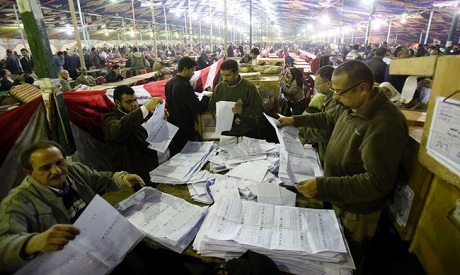
Vote counting in Egypt's 2011 elections (Photo:Reuters)
The new system in Egypt’s 2011 elections may seem overwhelming to those trying to figure out how the winners will be calculated. The introduction of the list system and calculations using the ‘largest remainder’ method has been a cause for confusion. Also, in the individual system, voters can now vote for any two candidates as opposed to one professional and one worker/farmer. Ahram Online examines the various rules involved in determining the winners of the elections.
How individual winners are determined per district
Each district will have two seats to be awarded to two candidates. At least one of them must be a worker/farmer.
Winners
In the first round a candidate may win a seat by getting a number of votes greater than 50% of the total number of ballots (50% +1 vote). Meaning if a total of 10,000 voters cast their ballots correctly, a candidate would have to get 5001 votes to win a seat.
Since every voter must choose two candidates, each ballot contains two votes. This means the total number of votes made available by 10,000 voters will be 20,000 votes. It is then possible for two candidates to each win 5001 votes in the first round. Two candidates winning 5001 votes or more can secure seats in parliament without a runoff, provided one of them is a worker/farmer.
Candidates unable to secure a seat by garnering the necessary votes go to the second round or runoffs.
Runoffs and the 50% worker/farmers rule
The following are the different cases for which there is a runoff, either no candidates won or one of them did.
- If no candidate managed to secure the total number of votes, then the runoffs will include the top two professionals and the top two workers.
- If the winner in the first round was a professional, the top two worker/farmer candidates compete in a second round.
- If the first winner was a worker/farmer, the next two candidates with the highest votes compete in a second round irrespective of their category
- If two candidates were elected in the first round and were both professional then only the one with the highest number of votes will be chosen and the top two worker/farmer candidates will compete in a second round.
How list winners are determined per district
Each district will have several seats to be distributed to the lists participating in the district. A single district may have four, six, eight, ten or 12 seats.
How are lists ordered?
Lists are ordered so that no two consecutive professionals appear on the list. Any candidate can be placed on the top of the list.
Seat Cost
In each district there are a number of seats assigned to it for lists. Each seat has a cost in the number of votes. This cost is determined as the total number of votes divided by the number of seats. For example if there are 100,000 votes for 4 seats, the cost of 1 seat would be 25,000 votes. If there are 8 seats, the cost of one seat would be12,500 votes.
Let’s take the example of one seat costing 25,000 votes. If one list receives over 25,000 votes it will be granted one seat. If a list receives over 50,000 votes, it receives 2 seats.
What about fractions of a seat?
Fractions of the full cost of a seat follow certain rules determined by a system called the largest remainder. In its simplest form, after all the whole seat quotas (e.g. 25,000) has been deducted from the total number of votes for each party, the largest number of votes remaining for any of the lists receives a seat.
Example:
Total number of valid votes: 100,000
Number of seats in district: 4
Cost of one seat = Total Number of Valid Votes / Number of seats = 25,000
6 lists, 4 seats in contention | |||
|---|---|---|---|
List Name | Votes | Seats Won | Remainder |
| The Revolution Continues | 40,000 | 1 | 15,000 |
| Freedom and Justice | 23,000 | 0 | 23,000 |
| The Egyptian Bloc | 12,000 | 0 | 12,000 |
| Al-Wasat | 17,000 | 0 | 17,000 |
| Al-Wafd | 5,000 | 0 | 5,000 |
| Al-Nour | 3,000 | 0 | 3,000 |
Because the revolution continues got more than the quota or cost for one seat, it is awarded a seat. The rest of the parties did not get enough votes to secure one seat. So where do the remaining three seats go? They go to the largest remainders after the full votes for a complete seat are subtracted.
The three largest remainders are: Freedom and Justice Party (23k), Al-Wasat (17k) and Revolution Continues (15k).
The three seats go to the three largest remainders.
Nationwide Constraints
In order for a list to be eligible to win any of the seats, a list must have won at least 0.5% of the nationwide valid votes.
How are seats allocated within the list?
The general rule is that each list has an ordered list of candidates. The candidates chosen on the list are by order. The candidates on the list win the seat according to their order within a list. If for example a list wins three seats, then the first three on the list have seats in parliament.
50% worker/farmer rule
The exception to this rule is when the professionals that will be in parliament are more than 50%. In this case, one of the lists will have to skip the professional and give the seat to the next worker/farmer on the list. The list that will have to suffer this is the one with the least ‘coefficient’.
A ‘coefficient’ is calculated as = total number of valid ballots / number of seats won by list.
Workers/Farmers
Who is a worker?
A worker is a person who depends mainly on his income from his manual or mental work. He shall be a member of a trade union and holds a high academic qualification.
Who is a farmer?
A farmer is an individual whose sole profession and main income is through farming, lives in the countryside and does not own more than 10 feddans of land.
Nationwide Numbers for Peoples’ Assembly
Seats
- Number of elected individual seats: 166 (1/3 of total seats)
- Number of elected list seats: 332 (2/3 of total seats)
- Total Number of elected seats: 498
- Percentage of seats that must be allocated to farmers/workers: At least 50 %
Electoral Districts/Constituencies
- Total number of electoral districts / constituencies for lists: 46
- Total number of electoral districts / constituencies for individuals: 83
Seats per district/constituency for lists
- 15 districts have four seats
- One district has six seats
- 19 districts have eight seats
- Nine districts have 10 seats
- Two districts have 12 seats
Subscribe to:
Posts (Atom)